Back in January, Ramona Fradon announced her retirement, after a long career of drawing comics. A few weeks later, on February 24 this year, she passed away at the age of 97. Here are Mark Evanier announcing her death, her obituary in The New York Times (not many comic book artists get one of those!), and two stories about Ramona from Evanier. Perhaps her greatest contribution to comics was co-creating Metamorpho, but here she will always be known for her stellar work on Aquaman. And thanks to my being a fan of The Wizard of Oz, we have an original Ramona Fradon drawing of Aquaman in our house. Back when the annual Oz-Story anthology was a thing, I noticed one of the comic stories one year was illustrated by Fradon. Since I know the people behind Oz-Story, I wrote to them and asked for her contact information. I was able to reach her and commissioned an original Aquaman for Laura, and presented it to her at Christmas. I don't think she has ever been more surprised or delighted at anything I have ever given her. It was completely unexpected, and it still holds a place of honor in our bedroom. If I remember correctly, Laura then got to meet Ramona in person at San Diego in 2001, and got another little free sketch from her, and got to gush in person.
Thursday, March 21, 2024

Wednesday, March 20, 2024
Newbery Medal Winners: Waterless Mountain and Young Fu of the Upper Yangtze
I have been remiss in blogging about the Newbery Medal winners as I've read them. I read Waterless Mountain, the 1932 winner, some time ago, but life got in the way of writing about it until after I recently finished Young Fu of the Upper Yangtze, the 1933 winner. So now I get to write about them at the same time. But this is not so bad, as both books have similar stories and themes, about young men growing up in what would be a much different culture from their own for many readers in 1930s America. Younger Brother, the main viewpoint character of Waterless Mountain, is a Navajo youth in contemporary Arizona who wants to be a medicine man. Young Fu is a Chinese youth who becomes an apprentice to a coppersmith in 1920s China. We see both of them grow up, learn about their trades, have encounters with many characters, deal with events and changes in their lives, and come into their own as young men. This says a lot about what librarians in the 1930s considered to be good literature for children, but at least they saw merit in diversity. Both books do suffer from being filtered through white eyes (both authors were European-descended American women who spent some time in the areas the books take place in). They do stand up well today, at least, even if some of the attitudes feel old-fashioned.
One interesting motif in both books is the protagonists' encounters with white people. Younger Brother has several encounters with the man who runs the local trading post, and later befriends a young man who gives him a ride in his car. Young Fu comes to the aid of a nurse from the local Christian hospital, and they end up helping each other out several times over the years. There are mentions or allusions to other less-than-friendly white people, but they don't take part in the action.
Okay, I'm not sure what else I can say about these two books without extensive research and rereading. I think you've got the gist, though. Since the next book is a biography of Louisa May Alcott, I suspect it's not going to be so similar to these!
Thursday, November 05, 2020
Newbery Winners: The Trumpeter of Krakow
Hi, Eric here again with one of my rare posts here. Yes, I'm still trying to read all of the Newbery Medal winners in order, and with The Trumpeter of Krakow by Eric P. Kelly, we wrap up the 1920s with an exciting adventure of intrigue and mystery and all that stuff that makes for a pretty good story. Kelly had spent time in Poland not long after it was established following the Great War, and grew to love and appreciate the country and its people, which really shows in the book. He really brings medieval Krakow to life. Which is good, because the book's protagonist, Joseph Charnetski, has to learn about it, as his family have had to flee their village. His father hopes to stay with a cousin in the city, but he has been murdered and his estate seized, so the Chartenskis have no friends or resources to help them. But they save the life of a kindly alchemist who offers to help them, and finds not only a place to live, but also work, as the trumpeter who plays "the broken hymn", the Heynal, at the Church of Our Lady St. Mary every hour. While the job is primarily his father's, Joseph helps out and learns the Heynal himself, which becomes useful when those who are seeking out the Charnutski family and the incredible secret they are hiding come to Krakow. Through a secret code in his playing of the Heynal, Joseph is able to alert his friend, the alchemist's niece, who raises the alarm and helps save the family. It is not enough to stop the Great Fire of Krakow, but all ends up working out well in the end. It's an exciting, well-paced historical novel, and worth the effort to track it down. Yes, thanks to the COVID-19 pandemic, getting a copy of the book to read was a bit of an adventure. Our local library was completely shut down, so I couldn't borrow their copy. I ordered an inexpensive used copy online, but the sent the wrong book! No problem, it was a book I wonted to read anyway, and they refunded my money, but I was still without the book to read. But by this time, the library was open again, at least for no-contact deliveries of reserved books, so I finally got the chance to read it. But interlibrary loan is still curtailed, and since they don't have the 1930 winner in their system, I may have to venture into the used book market again. Ah, but that will just have to wait for my next entry on this blog, most likely.
Saturday, March 10, 2018
Newbery Winners: Shen of the Sea
The fifth book to win the Newbery Medal, which it did in 1926, is Shen of the Sea by Arthur Bowie Chrisman, a collection of short stories set in China. The tales are not at all connected. I suspect this would be a hard book to get published today, as some aspects of Chinese culture that it depicts have not aged well. But it's also not horrible, either, and holds up a lot better than many other books of the time, I'm sure. (And let's face it, just about anything written for children nearly a century ago is going to feel quaint and dated anyway.) Although I gather these stories were originally created by Chrisman, they read like old folk tales. Some are just little slice-of-life stories, but others delve into the origins of aspects of Chinese culture (printing, chopsticks, pottery, kites, tea, gunpowder), and others show people thinking outside the box, or tricking demons, or just being clever. It's a fun, light read, and I enjoyed this one a lot.
Thursday, April 06, 2017
Reading the Newbery Winners: The Dark Frigate
I'm still not quite sure what to make of the third Newbery Medal winner, The Dark Frigate by Charles Hawes. It's not written quite like a modern day children's book, so it was a little harder for me to get into it at first. But the story of Philip Marsham and his struggles to find a place in the world of seventeenth century England will look pretty familiar to many readers. The early chapters reminded me of something Charles Dickens might write, with his becoming orphaned and cast from situation to situation before finally landing a place on a ship, the Rose of Devon. Then things turn into something more like Robert Louis Stevenson, as the ship is taken by pirates, and Phil must hold on to his values and ideals in a situation that makes that extremely difficult. He comes out all right in the end, of course, but he has many adventures before it's all over. There are many hints of even more adventures, but sadly Hawes died shortly before the novel was published, so he never got the chance to see his prize, nor write more about Marsham.
Sunday, December 04, 2016
Reading the Newbery Winners: The Voyages of Doctor Doolittle
Oh, this was fun, and took me back. By the time I became a voracious reader in the early '70s, the Doctor Doolittle books had fallen out of favor and quietly gone out of print. I didn't know that at the time, however, and my school library still had many of them, which I enjoyed reading at the time. So I was eagerly looking forward to the second Newbery winner, The Voyages of Doctor Doolittle. However, since that is actually the second book in the series, I decided to also read the first book, The Story of Doctor Doolittle as well. Fortunately, my local library system has the very nice (and ever so slightly edited to keep up with the times) editions of both books published by Books of Wonder with afterwords by my friend Peter Glassman. (Sadly, these editions seem to now be out of print as well.)
So, first off, a quick look at The Story of Doctor Doolittle: It does a terrific job of establishing the Doctor and his world, and how he came to change from a doctor for humans to a doctor for animals who could actually talk to them and find out what was wrong with them rather than poke and prod and guess like your standard veterinarian. And of course we find out how he learned to talk to animals in the first place, thanks to one of the best characters in the series, the long-lived and very experienced parrot Polynesia. Doolittle gains fame in the animal world by curing a disease among the monkeys of Africa, after running afoul of the king of Jolliginki, but it is Prince Bumpo who helps the Doctor get back to England after Doctor Doolittle helps Bumpo achieve one of his fondest wishes. (Those familiar with the original version of the book can probably understand why this is probably the biggest change made in the Books of Wonder edition. Fortunately, it includes a thorough foreword that explains the original and why the changes were made.) It was a surprisingly quick read, and does a good job of building this world and developing the Doctor's character.
Now the main attraction: The Voyages of Doctor Doolittle. Much to my surprise, this was not a slight little book, but a much larger volume, over twice as long, and divided into six parts! It still proved to be a quick read, however, as this is a rollicking series of adventures. We get to see a lot more of Doctor Doolittle's life in Puddleby through the eyes of a new character, Tommy Stubbins, the cobbler's son. Tommy is the narrator for this book (and much of the rest of the series, if I recall correctly), and that new, up-close perspective really opens the story up. Stubbins (as the Doctor calls him, making him feel very grown up) becomes Doolittle's assistant and pupil, and also learns to talk to the animals. Through Stubbins' eyes we learn more about the Doctor's house, how so many animals can live there, and how the Doctor and his friends go about their lives. Much of the first third of the book takes place in Puddleby, but before long they decide to go on a voyage, in part to investigate the disappearance of another famed naturalist, Long Arrow. But first, they need a crew for their new ship—which leads to trouble when they try to recruit Luke the Hermit. It turns out that Luke is a fugitive from the Mexican law (hence his becoming a hermit) whose past has caught up with him. The trial proves to be one of the biggest events in Puddleby's history, but thanks to Doctor Doolittle being able to interpret for Luke's dog, Luke is found not guilty and is then reunited with his wife. Since Luke isn't available anymore, the Doctor's old friend Bumpo makes a timely visit during a break from his studies at Oxford and is then recruited instead. Bumpo, Stubbins, and several of the animals prove to be an able crew. After putting a stop to the bullfights in some Spanish islands along the way and many adventures at sea, the crew eventually makes its way to Spidermonkey Island, save Long Arrow, brings about peace between the two warring factions, and anchors the island after it drifts too far south (yes, Spidermonkey Island is—well, was, now—a floating island). So of course he is made King of the island, which is exactly what a humble man like Dr. John Doolittle doesn't want. Nevertheless, he is a kind and extremely proactive king, and makes Spidermonkey Island a very nice place to live. His friends all realize that unless they take action, he will never leave, so they conspire to give him a way to get back to Puddleby, which he eventually takes, albeit reluctantly.
Yes, this book was a lot of fun, and to be honest, the doctor is much too humble! He is a good doctor, but also a brilliant and clever naturalist and linguist, and a kind and compassionate soul. He doggedly tries to learn the shellfish language throughout the book, and brilliantly succeeds in the end. And to be honest, I now can't recall if I ever read this book before! I remembered bits and pieces as I read, but I think a lot of that came from the musical film. Many of the incidents that weren't in the movie I don't remember at all. But it has also been at least forty years since I read any of the books, so I may just have forgotten. But I have really enjoyed reading about Doctor Doolittle again, and I may very well see if interlibrary loan or cheap used books can help me read the rest of the series, just for fun.
Monday, July 25, 2016
Reading the Newbery Winners: The Story of Mankind
Hi, everyone. Eric here, Laura's husband. This blog technically belongs to both of us, and Laura lets me blog here on occasion. But I haven't done it very often just because Laura says enough here for both of us, and I have my own blog for the stuff I really want to talk about. But I started a new project this year, and figured this would be the place to talk about it.
So what is my project? Read all of the winners of the Newbery Medal, the highest honor given for children's literature published in the United States. And I am reading them in order! So naturally I started with the very first winner, The Story of Mankind by Hendrik Willem van Loon. I've already read at least a dozen of the winners, and based on those this is nothing like what I would have expected! For one, it's non-fiction. Van Loon traces all of western history and civilization from cavemen, through to the earliest civilizations, Greece, Rome, the Middle Ages, the Renaissance, and all that's happened since then. It's a very ambitious piece of work, but it also does an excellent job of tying all the strings of history together. I like to think I'm a pretty smart guy, and I certainly know a few things about history, but through this book I saw many connections that I have missed in my previous education. I will add that my edition is not the version that won the Newbery, but a later edition, as it has beet added to frequently since its original publication. The latest copyright date in mine is 1984, so it's not the most recent, but it sue gave me a good taste of the original. It was a long book, and a challenge to read at times (and I'm an adult, so imagine how hard this might be for many kids), but ultimately it was worth the effort to see how the world got to be the way it is today.
Monday, January 23, 2012
We have a cat!!!
Eric, here, giving a Gjovaag household update. We seem to have been adopted by a cat! I don't know all of the details, but this little black kitten was found at the newspaper, all covered in oil, so that when you petted him, he left inky black spots on your fingers. That, and where he was found, led to him being dubbed Inkwell. Laura took him to the vets and got him cleaned up and trimmed, and Inkwell is now in our guest bathroom with all of the proper cat fixtures. We're currently planning for this to be a temporary stay, and the paper is running an ad to find him a home. But he is a cute little fellow, and very personable... (although I think I hear him scattering kitty litter around right now...)
Wednesday, December 21, 2011
Monday, October 17, 2011
Trick or Treat for UNICEF online!
Hi, everybody. Eric here. You may know me from such blogs as "I Am a Teacher" and "The Wonderful Blog of Oz". Well, today, I come to ask for your help. For the past few years, through my Oz website, I've tried to raise funds during the Halloween season for Trick or Treat for UNICEF. In previous years, I've raised twenty dollars. That's not per year, that's total! So this year, I've decided to try something different: I'm telling people about it! (I know, radical concept!) So, consider this me telling you about it. If you can spare a dollar or two (or, better yet, five or ten or so) to help children around the world, take a look at my donation page. Thanks, and feel free to spread the word. But hurry! It all ends on Halloween!
Wednesday, July 06, 2011
Tuesday, June 28, 2011
Best! Horse Race! Ever!
Those folks at Improve Everywhere have done it again! Take a look at this!
For more about this mission, especially the behind-the-scenes fun, go to Improv Everywhere's website.
Wednesday, June 08, 2011
Printer error messages
I found this set of printer error messages (probably from Aaron Williams, who has some of the best linkdumps around), and they made me chuckle, with the occasional guffaw. I hope you like them, too. It seems you can hack your printer and alter some of the messages in there...
Saturday, May 21, 2011
Sunday, April 24, 2011
The Hugo Nominations!
Hi, everybody. Co-blogger Eric here. Laura wants me to post the news that the nominations for the Hugo Awards have been announced. So, here it goes: The Hugo Award nominations are up on the web. Three Doctor Who stories were nominated for Best Dramatic Presentation, Short Form: "Vincent and the Doctor", "The Pandorica Opens"/"The Big Bang", and "A Christmas Carol". Also nominated in the Best Related Works category is the great little book of Whovian essays, Chicks Dig Time Lords. And Girl Genius got another nomination for Volume 10: Agatha Heterodyne and the Guardian Muse in the Best Graphic Story category.
Thursday, April 21, 2011
You have an appointment...
Hi, everybody. Eric, here. I just wanted to tell you that the always great Springfield Punx blog (Dean is an artist who likes to reimagine characters in the style of The Simpsons) has a great desktop picture to go along with this weekend's other big event. Oh, heck, just go here to see it.
Sunday, February 06, 2011
Things to do with a lamppost
Author Neil Gaiman has two dogs and lives out in the Minnesota countryside. So of course, he has a lamppost. Then the neighbors and their photographer friend had a bright idea... Go take a look at the results.
Friday, January 07, 2011
Monday, November 29, 2010
Thursday, October 21, 2010
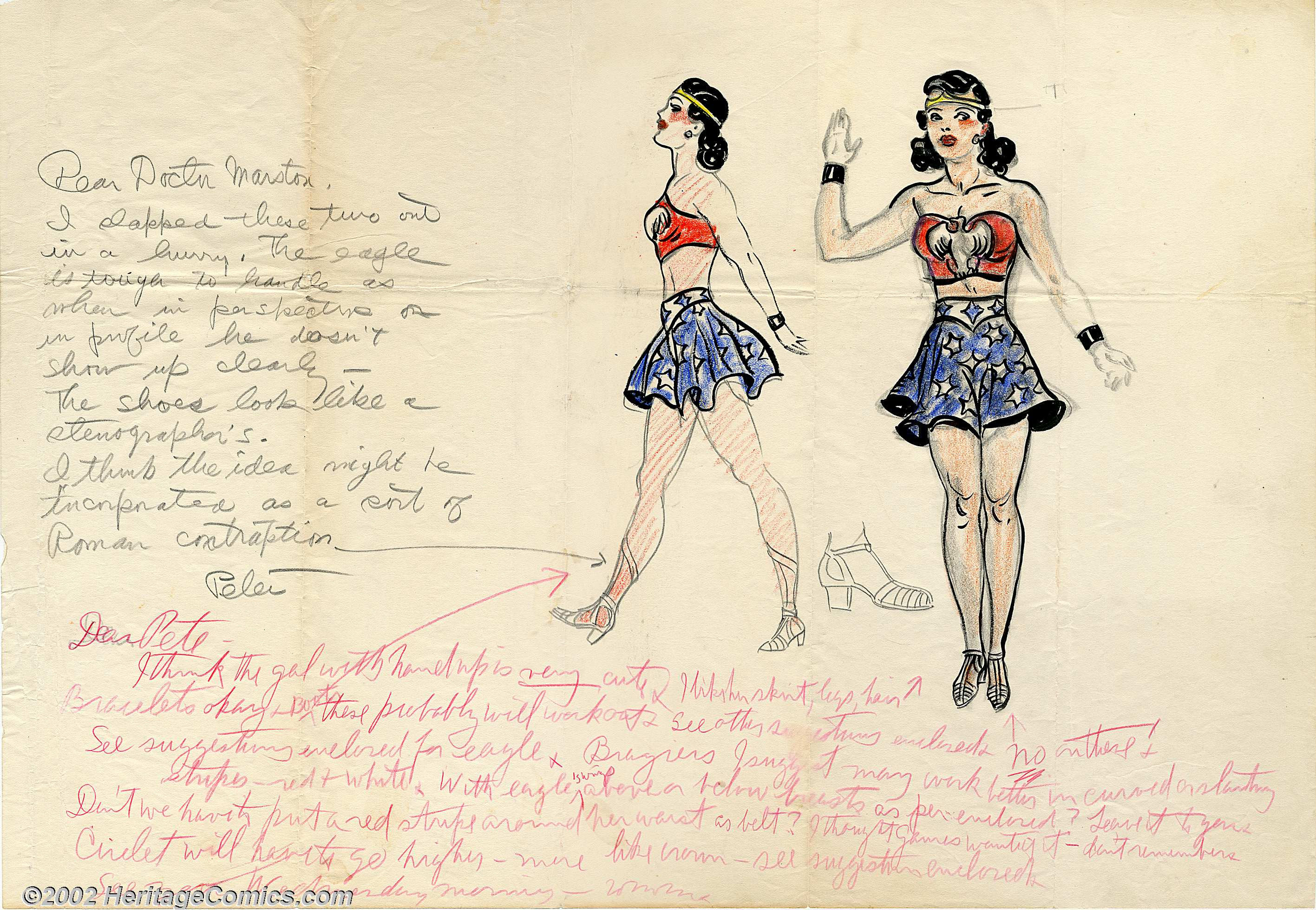
Original Wonder Woman Sketch
Wow, look what I found online! It's the original 1941 sketch of Wonder Woman, with William Marston's notes. Cool! It's right here.


 Posts
Posts



